What is revenue cycle management (RCM) in healthcare?
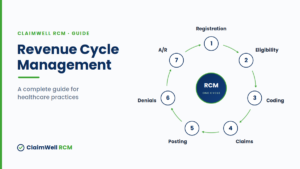
Revenue cycle management is the entire financial process of a healthcare practice, from scheduling and insurance verification through coding, claim submission, payment posting, denial management, and patient collections. When any single step breaks down, claims are delayed or denied and cash flow suffers. Strong RCM keeps every stage connected so revenue is captured accurately and paid on time. ClaimWell manages the full cycle for practices across many specialties, so providers can focus on care instead of paperwork.
What does a medical billing company actually do?
A medical billing company translates the care you provide into accurate claims, submits them to payers, posts the payments, and follows up on anything unpaid. The most common problems practices face are coding errors, missed filing deadlines, and denials that never get reworked, and each quietly reduces the revenue you have already earned. Left unmanaged, those small leaks add up to a meaningful share of annual income. ClaimWell handles billing end to end, with certified coders and dedicated follow-up, so more claims are paid correctly the first time.
What is provider credentialing and why does it take so long?
Credentialing is the process of enrolling a provider with insurance payers so the provider can bill and be reimbursed. It is slow because each payer has its own application, documentation, and verification steps, and a single missing item can restart the clock. The cost of delay is real: a provider may be seeing patients while unable to bill, creating weeks or months of lost revenue. ClaimWell manages the full process, tracks every application, and follows up with payers to keep timelines as short as possible.
How is insurance credentialing different from a state license?
A state license and practice authority allow you to legally treat patients, while insurance credentialing enrolls you with specific payers such as Medicare, Medicaid, and commercial plans. You can be fully licensed and still unable to bill a payer until you are credentialed and contracted with them. Many practices assume licensure is enough and are surprised when early claims are rejected as out-of-network. ClaimWell coordinates credentialing and payer enrollment so your ability to bill matches the plans your patients actually carry.
What is CAQH and why does it matter for credentialing?
CAQH is a centralized online profile that most commercial payers use to collect and verify provider information during credentialing. If your CAQH profile is incomplete, out of date, or not re-attested on schedule, payer applications stall. Because so many payers pull from the same profile, one neglected CAQH record can hold up several enrollments at once. ClaimWell sets up and maintains CAQH profiles and keeps attestations current, so credentialing is not delayed by avoidable gaps.
Why do insurance claims get denied, and what can be done about it?
Claims are denied for many reasons, including eligibility problems, missing authorizations, coding errors, and late filing. The larger issue is that many practices never rework their denials, so that revenue is simply written off. Every unworked denial is money you earned but never collected. ClaimWell categorizes each denial by root cause, appeals it quickly with the right documentation, and corrects the upstream issue so the same denial stops recurring.
What is denial management and how does it protect revenue?
Denial management is the disciplined work of tracking, appealing, and preventing claim denials. Without it, denials pile up, age past appeal deadlines, and become permanent losses. Even a modest denial rate compounds into significant lost revenue over a year. ClaimWell works denials daily, appeals with supporting documentation, and reports on denial trends so the underlying problems are fixed at the source rather than repeated.
What is insurance eligibility and benefits verification?
Eligibility and benefits verification confirms a patient's active coverage, copays, deductibles, and any authorization requirements before the visit. When it is skipped, claims are denied on the back end and patients receive surprise bills. This front-end step prevents a large share of avoidable denials and protects the patient relationship. ClaimWell verifies coverage ahead of appointments so claims go out clean and patients know what to expect.
What is accounts receivable (A/R) follow-up in medical billing?
A/R follow-up is the ongoing work of pursuing unpaid and underpaid claims until they are fully resolved. Claims that sit untouched age into 60, 90, and 120-day buckets and eventually pass the payer's filing deadline. Rising A/R days are one of the clearest warning signs of a struggling revenue cycle. ClaimWell works aging claims by payer and deadline every day, so fewer dollars are lost to the clock.
Why is accurate medical coding so important?
Medical coding translates clinical care into standardized ICD-10, CPT, and HCPCS codes that determine how a claim is paid. Under-coding leaves earned money on the table, while incorrect or unsupported coding creates denials and compliance risk. Getting it right protects both revenue and the practice itself. ClaimWell's certified coders apply accurate codes and modifiers reviewed against payer rules, balancing full reimbursement with clean compliance.
How does HIPAA compliance affect medical billing?
HIPAA governs how protected health information is accessed, transmitted, and stored, and billing touches that data at every step. A careless workflow or an untrained vendor can expose a practice to breaches and penalties. Compliance is not optional, and it should not slow your billing down. ClaimWell uses secure, role-based access and HIPAA-conscious workflows, so billing stays both efficient and protected.
How do insurance claims move from a visit to a payment?
After a visit, the encounter is coded, a claim is created and scrubbed for errors, and it is submitted electronically to the payer, which then adjudicates and either pays, adjusts, or denies it. Problems anywhere in that chain, such as a bad code or a missing authorization, stop the payment and require rework. Understanding the full path is what makes it possible to prevent errors rather than chase them. ClaimWell manages each step and reconciles every payment against what was billed, so discrepancies are caught quickly.
How can outsourced billing improve my practice’s revenue?
Outsourced billing improves revenue by reducing denials, submitting cleaner claims, and following up on every dollar owed, without the overhead and turnover of an in-house team. Many practices do not realize how much they are losing to small, recurring leaks until an outside team measures it. The typical result is steadier, more predictable cash flow. ClaimWell provides a full billing team plus transparent reporting, so you can always see what is billed, paid, and pending.
How do you help a practice grow revenue over time?
Sustainable revenue growth comes from consistently capturing every billable service, minimizing denials, and shortening the time from visit to payment. Practices often focus on seeing more patients while overlooking the revenue leaking from the volume they already have. Fixing the cycle first means growth does not simply add more waste. ClaimWell tightens the revenue cycle and reports on the metrics that matter, so growth actually translates into collected dollars.
Do you work with solo and private practices?
Yes. Solo and private practices often carry the same billing complexity as larger groups but with far less administrative support, which makes them especially vulnerable to denials and slow collections. That imbalance is where revenue quietly disappears. ClaimWell gives private practices a full billing and credentialing team without the cost of building one in-house, along with a dedicated point of contact who knows their practice.
Do you support group and multi-provider practices?
Yes. Group and multi-specialty practices manage multiple providers, payer contracts, and service lines, which multiplies the opportunities for coding and enrollment errors. Inconsistent billing from one provider to the next can drain revenue without anyone noticing. ClaimWell standardizes billing across the group, manages credentialing for each provider, and reports at both the provider and practice level so leadership has a clear view.
Does ClaimWell only handle behavioral health billing?
No. ClaimWell is a full-service revenue cycle management company serving practices across many specialties, including primary care, multi-specialty groups, and more, with behavioral health as one area of expertise. We built deep experience in behavioral health because its session-based and time-based coding is demanding, and that same discipline benefits every specialty we serve. If you bill it, we can most likely manage it.
What makes behavioral health billing different from other billing?
Behavioral health billing relies heavily on time-based and session codes, specific modifiers, and payer rules that differ from general medical billing. Small errors in session length, coding, or authorization lead to denials that are easy to miss at volume, and because visits are frequent and recurring, those errors compound quickly. Handling it well takes specialty-specific knowledge. ClaimWell applies that behavioral health expertise while treating it as one specialty within a broader, multi-specialty RCM practice.
What is primary care billing and what makes it challenging?
Primary care billing spans office visits, preventive care, chronic care management, and wellness visits, each with its own coding and documentation rules. Because visit types vary so widely, it is easy to under-code preventive and chronic-care services that are fully reimbursable, and that lost revenue adds up across a busy panel. Accuracy across the full range of services is what protects the bottom line. ClaimWell codes primary care encounters correctly so practices capture everything they have earned.