
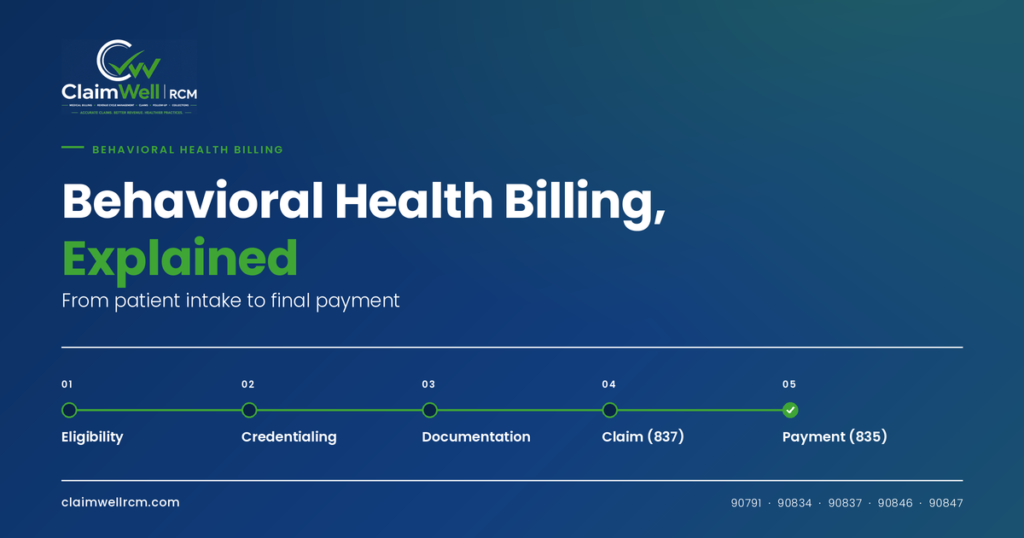
Behavioral health billing is far more than submitting insurance claims. Behind every paid claim is a structured workflow that begins before the first appointment and continues until payment has been posted and any remaining balance has been resolved.
For behavioral health practices — psychotherapy, psychology, psychiatry, counseling, and group practices — even a small breakdown in that workflow can lead to delayed payments, denied claims, heavier administrative load, and unpredictable cash flow.
This guide walks through the complete behavioral health billing process stage by stage, so practice owners can see exactly where revenue is won and lost, and clinicians can spend more of their time on patient care.
In this guide
- What is behavioral health billing?
- The billing workflow at a glance
- Step 1: Registration and insurance verification
- Step 2: Provider credentialing and payer enrollment
- Step 3: Scheduling and patient intake
- Step 4: Clinical documentation
- Step 5: Behavioral health CPT coding
- Step 6: Claim creation and submission
- Step 7: Payment posting and reconciliation
- Step 8: Denial management and appeals
- Step 9: Accounts receivable follow-up
- Common billing challenges
- Why workflow matters more than individual tasks
- Best practices
- Frequently asked questions
What Is Behavioral Health Billing?
Behavioral health billing is the process of documenting, preparing, submitting, and managing insurance claims for mental health services.
It involves far more than entering CPT codes or transmitting claims electronically. An effective billing process connects clinical documentation, insurance verification, provider credentialing, coding, claim submission, payment posting, and accounts receivable management into one coordinated workflow.
Behavioral health also carries rules that differ sharply from general medical billing:
- Time-based session codes that hinge on documented face-to-face minutes
- Frequent prior authorization and medical-necessity requirements
- High claim volume from recurring weekly or twice-weekly visits
- Carved-out benefits, where mental health coverage is administered by a separate behavioral health vendor rather than the medical plan
- Licensure-dependent billing, including supervision and co-signature requirements for provisionally licensed clinicians
A successful process depends on collaboration between clinicians, administrative staff, billing specialists, and payers. Practices working across multiple service lines — psychiatry, psychology, and psychotherapy — often have to manage several sets of payer rules at once.
The Behavioral Health Billing Workflow at a Glance
Although every practice is unique, most successful behavioral health revenue cycle management follows the same nine stages:
- Patient registration and insurance verification — confirm coverage, benefits, and authorization requirements before the first visit
- Provider credentialing and payer enrollment — confirm each clinician is enrolled and effective with every payer they will bill
- Scheduling and patient intake — complete consents, financial policies, assessment, and diagnosis
- Clinical documentation — record the service, including start and stop times
- CPT and diagnosis coding — select codes that match the documented service
- Claim creation and submission — scrub, validate, and transmit the claim electronically
- Payment posting and reconciliation — post remittances and confirm payment against the contracted rate
- Denial management and appeals — work every denial to root cause
- Accounts receivable follow-up — pursue aging claims and resolve patient balances
Each stage feeds the next. That is the single most important idea in this guide, and it is worth keeping in mind as we work through the detail.
Step 1: Patient Registration and Insurance Verification
The billing process begins before the patient attends their first appointment. Collecting accurate demographic and insurance information here prevents avoidable rejections later.
During this stage, practices typically verify:
- Active insurance coverage on the date of service
- Behavioral health benefits specifically, including whether they are carved out to a separate vendor
- Copayments, coinsurance, and remaining deductible
- Referral requirements
- Prior authorization requirements and any visit limits
- Telehealth eligibility, when applicable
- Coordination of benefits, if the patient has more than one plan
Two details are easy to miss. First, a plan can be active for medical services while behavioral health benefits sit with a different administrator, which means claims sent to the medical payer will be routed incorrectly. Second, deductibles reset at the start of the plan year, so a patient who owed nothing in December may owe the full session rate in January.
Verification is not a one-time task. Re-verifying at the start of each new episode of care, and periodically for long-term patients, catches coverage changes before they become write-offs.
Step 2: Provider Credentialing and Payer Enrollment
Before services can be billed to most insurance plans, providers must complete the appropriate credentialing and enrollment process.
Credentialing may include:
- Individual provider enrollment
- Group practice enrollment and linkage of the provider to the group
- CAQH profile maintenance and re-attestation
- NPI verification
- Taxonomy code confirmation
- Payer participation and contracting
- Revalidation on the payer’s schedule
Many behavioral health billing delays occur because providers begin seeing patients before payer enrollment has been fully completed or activated. Timelines commonly run from around 60 to 120 days, and longer with some payers.
Two distinctions matter more than most practices expect:
- Approval is not the same as an effective date. A payer may approve a provider while setting an effective date weeks later. Sessions before that date are usually not billable.
- Being credentialed with a payer is not the same as being ready to bill it. The provider still has to be correctly linked to the group’s tax ID, billing NPI, and service location in the payer’s system.
Retroactive billing is rarely permitted, so credentialing gaps tend to become permanent revenue loss rather than delayed revenue. If you are onboarding clinicians, our credentialing and enrollment service handles enrollment, revalidation, and panel updates so billing is not held up.
Step 3: Scheduling and Patient Intake
Once eligibility has been confirmed and the provider is appropriately credentialed, the patient completes the intake process.
Typical intake documentation includes:
- Consent forms and treatment consent
- Privacy notices
- Financial policy, including cancellation and no-show terms
- Clinical assessment
- Diagnosis
- Treatment plan
- A good faith estimate, where required for self-pay and uninsured patients
Accurate intake documentation establishes the foundation for future billing and supports medical necessity throughout treatment. A financial policy that patients have actually read and signed also makes patient balance collection far less awkward later.
Step 4: Clinical Documentation
Clinical documentation plays a critical role in behavioral health billing. Progress notes should accurately reflect the service provided and support the billed procedure code.
Depending on the practice structure, documentation may include:
- Progress notes with start and stop times
- Treatment plans
- Diagnostic evaluations
- Risk assessments
- Outcome measures
- Supervisor review and co-signature, where required
Because the main psychotherapy codes are time-based, documented minutes are not a formality — they are the justification for the code. Only direct therapeutic time with the patient counts. Scheduling the next appointment, collecting a copay, and writing the note afterward do not.
Incomplete documentation is one of the most common causes of delayed claim submission, because billing teams generally hold claims until documentation requirements are satisfied.
Step 5: Behavioral Health CPT Coding
Selecting the correct CPT code is only one component of successful behavioral health billing, but it is the component payers scrutinise most closely.
Common behavioral health CPT codes
| Code | Service | Commonly applied time |
|---|---|---|
| 90791 | Psychiatric diagnostic evaluation | — |
| 90792 | Psychiatric diagnostic evaluation with medical services | — |
| 90832 | Individual psychotherapy | 16–37 minutes |
| 90834 | Individual psychotherapy | 38–52 minutes |
| 90837 | Individual psychotherapy | 53 minutes or more |
| 90846 | Family psychotherapy, patient not present | 26 minutes or more |
| 90847 | Family psychotherapy, patient present | 26 minutes or more |
| 90853 | Group psychotherapy | — |
Add-on codes cover circumstances the base codes do not, including 90785 for interactive complexity and 90839 with 90840 for psychotherapy for crisis.
Three coding rules that cause most of the trouble
Time thresholds are hard edges. A 52-minute session is 90834. A 53-minute session is 90837. There is no rounding and no averaging, which is why start and stop times belong in every note.
90837 draws attention. Payers generally expect documentation that explains why an extended session was clinically necessary, such as symptom acuity, level of functional impairment, and the specific time-intensive interventions used. Routine use of 90837 without that support is a common trigger for post-payment review.
Psychotherapy with medication management is coded differently. When the same clinician provides both on the same day, the add-on psychotherapy codes 90833, 90836, and 90838 are reported alongside the appropriate E/M code, rather than the standalone codes 90832, 90834, or 90837.
Telehealth
Telehealth sessions generally require a telehealth indicator on the claim, most often modifier 95, together with the correct place of service — commonly POS 10 when the patient is at home and POS 02 when the patient is elsewhere. Requirements vary by payer and change periodically, so this is worth confirming against current payer policy rather than assuming last year’s rules still apply.
Step 6: Claim Creation and Submission
Once documentation has been completed and reviewed, claims are prepared for submission. This process typically includes:
- Diagnosis coding
- CPT coding and unit validation
- Modifier review
- Rendering and billing provider validation
- Eligibility re-check
- Clearinghouse scrubbing and payer-specific edits
Claims that pass validation are transmitted electronically to the payer for adjudication, most often as an 837 professional claim.
One distinction is worth making explicit, because it changes how quickly you have to act:
- A rejection never reached adjudication. The clearinghouse or payer refused the file over a format or data problem. It can usually be corrected and resent quickly.
- A denial was adjudicated and declined. It requires a correction, resubmission, or formal appeal, and it is subject to appeal deadlines.
Timely filing limits also vary widely between payers, commonly from 90 days to a full year from the date of service. A claim held for a missing note can quietly run out of time.
Step 7: Payment Posting and Reconciliation
After a claim has been processed, the payer issues one of the following:
- Payment
- Partial payment
- Denial
- A request for additional information
Payments arrive with a remittance advice — an 835 electronic remittance or a paper EOB — and are posted to the patient’s account. Posting is also the point at which underpayments surface, so it is worth reconciling what was actually paid against the contracted rate rather than simply accepting the payment.
Not every reduction on a remittance is a denial. A contractual adjustment such as CO-45 is the write-off you agreed to under your payer contract. A true denial withholds payment and needs to be worked.
Step 8: Denial Management and Appeals
Denials are best treated as data rather than as isolated problems. Sorting them by reason code usually reveals a workflow gap rather than a set of unrelated errors.
Denial codes behavioral health practices see most
| Code | What it usually means | Where it originates |
|---|---|---|
| CO-197 | Required precertification or authorization was absent | Before the visit |
| CO-16 | Claim lacks required information — check the accompanying remark code | Claim data |
| CO-29 | Timely filing limit has expired | Billing follow-up |
| CO-27 | Services provided after coverage terminated | Eligibility |
| CO-31 | Patient not eligible for the billed service | Eligibility or benefits |
| CO-97 | Service considered bundled into another already paid service | Coding and modifiers |
| CO-50 | Service not deemed medically necessary | Documentation |
Notice how many of these originate before the claim was ever submitted. CO-197 and CO-27 in particular are front-end failures that only become visible after the service has already been delivered and paid for in staff time.
A useful rule of thumb: if the same reason code appears on more than a small share of your monthly claims, the fix belongs upstream in the workflow, not in the appeals queue. Our denial management service works denials to root cause for exactly that reason.
Where a behavioral health service is denied in circumstances that would not apply to a comparable medical service, it may also be worth reviewing the decision against mental health parity requirements before writing it off.
Step 9: Accounts Receivable Follow-Up
Submitting claims is not the end of the revenue cycle. Practices should actively monitor outstanding balances through regular accounts receivable follow-up, which may include:
- Reviewing unpaid and no-response claims
- Appealing denials within the payer’s deadline
- Correcting and resubmitting claim errors
- Following up with insurance companies on aging claims
- Reconciling payments against contracted rates
- Managing patient balances and payment plans
Most practices track A/R in aging buckets — 0–30, 31–60, 61–90, and 90+ days — and work the queue by dollar value and filing deadline rather than by date order alone. Claims closest to a timely filing or appeal deadline should be worked first, regardless of size, because those are the ones that stop being recoverable.
Consistent accounts receivable management improves cash flow and keeps aging receivables from quietly becoming bad debt.
Common Behavioral Health Billing Challenges
Behavioral health practices tend to encounter the same recurring operational issues:
- Delayed or incomplete provider credentialing
- Eligibility verification errors, including missed benefit carve-outs
- Missing prior authorizations
- Incomplete documentation and missing session times
- Missing supervisor signatures
- Incorrect provider configuration in the payer’s system
- Time-based coding that does not match documented minutes
- Claim denials worked one at a time instead of by root cause
- Delayed payment posting
- Aging accounts receivable
Most of these originate earlier in the workflow rather than during claim submission itself.
Why Workflow Matters More Than Individual Tasks
Behavioral health billing should not be viewed as a series of isolated administrative tasks. It functions as a connected workflow where each step supports the next.
- A missed insurance verification produces a denied claim weeks later.
- An incomplete progress note delays claim submission, which can push a claim past a filing deadline.
- An unresolved credentialing issue prevents reimbursement altogether, no matter how clean the claim is.
Improving one part of the process rarely solves recurring revenue cycle problems if other gaps remain. A practice with a strong billing team and weak eligibility verification will keep producing preventable denials. You can see how we sequence these stages on our process page.
Best Practices for Behavioral Health Billing
Practices can strengthen billing operations by:
- Verifying insurance and behavioral health benefits before every new episode of care
- Confirming effective dates, not just approvals, when credentialing new clinicians
- Recording start and stop times in every session note
- Completing documentation promptly, ideally within a set internal deadline
- Scrubbing claims before submission rather than after denial
- Tracking denials by reason code and fixing the upstream cause
- Working A/R by dollar value and filing deadline, not just by age
- Reviewing payments against contracted rates to catch underpayments
- Running routine quality checks on the workflow as a whole
Standardised processes reduce administrative burden and make reimbursement far more predictable.
Frequently Asked Questions
How is behavioral health billing different from general medical billing?
Behavioral health relies heavily on time-based session codes, faces prior authorization and medical-necessity review more often, and generates high claim volume from recurring visits. Benefits are also frequently carved out to a separate behavioral health administrator, so claims can be denied simply for reaching the wrong payer.
Can a provider bill for sessions delivered before credentialing is complete?
Usually not. Most payers will only reimburse services delivered on or after the provider’s effective date, and retroactive billing is rarely permitted. This is why confirming the effective date — not just the approval — matters before a new clinician starts seeing insured patients.
What is the difference between CPT 90834 and 90837?
Both are individual psychotherapy codes, and the difference is documented face-to-face time. 90834 covers sessions of roughly 38 to 52 minutes and 90837 covers sessions of 53 minutes or more. The threshold is exact, and payers generally expect documentation supporting the clinical need for the longer session.
Why do behavioral health claims get denied so often?
The most frequent causes are administrative rather than clinical: missing authorizations, eligibility that was never re-verified, incomplete documentation, and coding that does not match documented time. Because these failures happen before submission, they are largely preventable with front-end controls.
How long does it take to get paid on a behavioral health claim?
Clean electronic claims are often adjudicated within a few weeks, though timelines vary by payer and state. Denials, appeals, and requests for records extend that considerably, which is why the speed of your follow-up matters as much as the speed of the payer.
Should a small practice outsource behavioral health billing?
It depends on volume, staffing, and how much of the workflow is currently unowned. Practices that are consistently behind on A/R, carrying repeat denials, or pulling clinicians into administrative work usually benefit from a specialised team. You can compare approaches on our pricing page.
Final Thoughts
Effective behavioral health billing extends well beyond submitting insurance claims. From patient registration and insurance verification through documentation, coding, claim submission, payment posting, and accounts receivable follow-up, every stage of the revenue cycle contributes to the financial health of the practice.
By building reliable workflows and addressing operational gaps early, behavioral health practices can reduce claim delays, improve reimbursement, and create a better experience for providers and patients alike.
How ClaimWell RCM Supports Behavioral Health Practices
ClaimWell RCM provides behavioral health billing services, provider credentialing, revenue cycle management, denial management, and accounts receivable support for mental health practices across the United States. We work inside your existing EHR, so there is no platform migration to manage.
If your practice wants to strengthen its billing operations or improve revenue cycle performance, get a free revenue assessment. We will review your current collections, denials, and A/R and share a tailored plan, with no obligation.
This article is general information about behavioral health billing workflows and is not coding, legal, or compliance advice. CPT code descriptors, time ranges, modifier requirements, and payer policies change, and individual payer rules vary. Always confirm current requirements against the applicable CPT guidance and your own payer contracts.
Leave a Reply